Featured Testimonial About Creighton University
The world is an incredible place, and every time I see a new part of it, I feel renewed. I can't imagine a place in the world where I could feel that more than in the Himalayas.

By Shannon Sherman
After a six-week journey marked by unexpected delays, harsh weather, moments of doubt, and even a yak shortage, Nicole Ostertag finally stood near the top of the world.

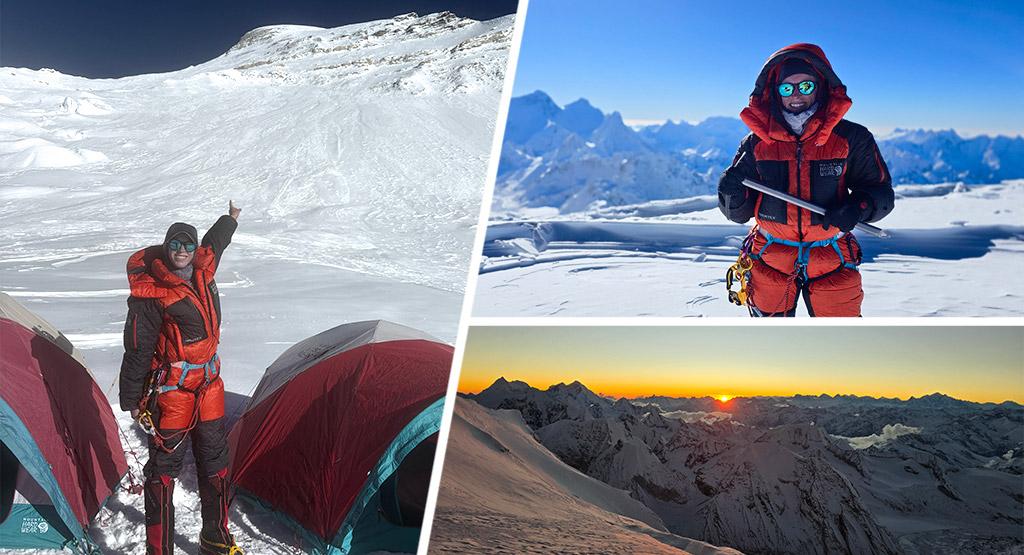
In October 2025, the Creighton grad was running on just a few hours of sleep in her tent at Camp Two (23,300 feet) on Cho Oyu in the Himalayas. At 12:30 a.m., she woke up to force down a little food and water and 90 minutes later, she started her push up the world’s sixth-highest mountain. By 9:45 a.m., she stood at the summit of Cho Oyu, 8,201 meters (26,906 feet) above the China (Tibet) – Nepal border.
The temperature hovered at minus 31 degrees. But the mountain gave Ostertag a gift that morning: sunshine on the summit. Clear skies, bright, breathtaking. She wasn’t cold. She wasn’t tired. And any lingering frustrations had slipped away.
“It’s an incredible feeling that’s really hard to put into words,” said Ostertag, BSBA'12, MBA'16. “There’s relief, but also the awe and wonder of being in a place that beautiful.”
Ostertag, her Sherpa guide and another Sherpa climber, the first three people to reach the top that day, enjoyed the view for 40 minutes (an especially long time at a Himalayan summit — another gift) while waiting for a handful of fellow climbers from the U.S.-based Madison Mountaineering expedition.
“I knew I could do it. I just didn’t know I could do it and enjoy it. The disruptions aside, I thoroughly enjoyed the process. Looking back, I thrived on the mountain.”
***
Ostertag didn’t grow up dreaming of mountaineering. “My family was not outdoorsy,” she said. “We were the Minnesotans who stayed inside all winter.”
After graduating from Creighton, she worked for Union Pacific. The Omaha-based railroad has a strong West Coast presence, and work eventually took Ostertag to Sacramento, California, in 2014, where she began hiking and backpacking with friends.
“Before I knew it, I'd climbed all the peaks that were dry and not technical.”
Curious about climbing higher, snowier peaks, Ostertag and a friend took a class with a local guide company and learned how to use crampons and ice axes properly. The next day, the two climbed the nearby Mount Shasta, the second-highest peak in the Cascades at 14,179 feet.
“We had a miserable night’s sleep with summer gear that wasn't appropriate for the temperatures,” Ostertag said. “But we were hooked. From there, I just tried to figure out how to get more knowledge and training to climb as many mountains as possible.”

Every vacation was spent climbing — Kilimanjaro, the Alps, and the Andes, including Ecuador’s Cotopaxi (5,897 meters), one of the world’s highest active volcanoes, and Aconcagua (6960 meters), the tallest peak in the Western Hemisphere.
She loved the wilderness, the beauty, the challenge.
***
Ostertag’s high-altitude climbing career accelerated when she took time off to change companies in 2019 and again when she relocated to Portland, Oregon, in 2021. That same year, she marked “Cho Oyu” on a vision board at G3 Enterprises, where she still works today as the senior director for global business development. Her boss and colleagues were supportive of her ambitions from the start.
“Focusing on the whole person, cura personalis, is something that I really value,” Ostertag said. “I moved to Portland to be a better version of me, and part of that is climbing. It makes me better at work and in other areas of my life.”
Cho Oyu is known as the most accessible 8,000-meter peak, though the summit is still in the “death zone,” where oxygen levels are insufficient to sustain human life. The mountain is typically less crowded and generally requires less technical climbing skill than some eight-thousanders. It tends to have fewer avalanches than other nearby mountains.
“Cho Oyu represented the least amount of risk for me to die from something I couldn’t control. That’s the brutal truth,” Ostertag said.
Ostertag planned her trip to Nepal for about a year, making special arrangements to be away from her job, her dog, and her house for four weeks. She hoped to summit with a Madison Mountaineering expedition in late September, when the weather would be ideal. Things didn’t go as planned.
The team arrived in Nepal during a time of government instability, and their climbing permits were delayed. Then the weather hit.
Monsoon season stretched further than expected, causing landslides and forcing the team to change their border crossing point into Tibet, where they planned to launch their climb from the north side of the mountain, trek to Base Camp, and begin acclimating to the extreme altitude.
Once in Tibet, they had to wait out a shortage of yaks, often used to transport gear to Base Camp.
An unexpected blizzard on the Tibetan side of the Himalayas forced guides and climbers to evacuate Cho Oyu and Mount Everest. As the trip extended into October, temperatures dropped.
“At Base Camp, you could walk 15 minutes around a corner, into the wind, and get one bar of cell service,” Ostertag said. “I made several calls to change flights and work arrangements, extend my dogsitter. I was upset, cussing at myself for making this decision. ‘What did I do? Why did I spend thousands of dollars to climb this mountain?’ For a long time, we didn’t think it was going to happen.”
But finally, two days into the summit push, in the wee hours of Oct. 13, the Madison Mountaineering crew awoke at Base Camp and took off for the summit. Ostertag felt good and climbed quickly with her Sherpa. She even joined the Sherpas in fixing ropes to the mountain to help others navigate the final stage of the climb (the snowstorm had buried the original ropes).
The final 20 minutes of climbing are across a summit plateau, a slope to the top of Cho Oyu, where climbers are rewarded with amazing views of Everest, Lhotse and other Himalayan peaks. Ostertag felt as if she were “in a totally different world.”
“I was ecstatic.”
***
Six months later, Ostertag reflected on the journey.

She spent almost six weeks away from home, mostly unplugged. She lived simply, “in a bubble” — just the mountain and her fellow climbers, working together to solve problems and achieve a goal. Coming down from the adrenaline high, integrating back into daily life in Portland, “sweating the small things,” wasn’t easy.
Family, friends, coworkers, and fellow climbers helped. And she couldn’t have completed the journey without her support system.
“There are very few things, at least that I've been exposed to in my life, that teach you more about yourself — the way that you think, and the way that you handle pressure — than this kind of climbing,” Ostertag said. “And sometimes you learn things that feel uncomfortable. You have to be open to feeling that, understanding that and choosing to accept it and grow.”
So, what’s next? Ostertag has already summited hundreds of peaks around the world, including roughly 15 over 5,000 meters, but she plans to keep climbing. She hasn’t ruled out attempting another eight-thousander in the Himalayas someday. Maybe Manaslu. Maybe even Everest.
“The world is an incredible place, and every time I see a new part of it, I feel renewed. I can't imagine a place in the world where I could feel that more than in the Himalayas.”