Featured Testimonial About Creighton University
My education at Creighton really showed me what makes people tick. It was extremely valuable for my FBI career because it taught me how to interview people and to listen to what they’re saying without passing judgment. That kind of approach pays off tremendously in investigations.
By Micah Mertes
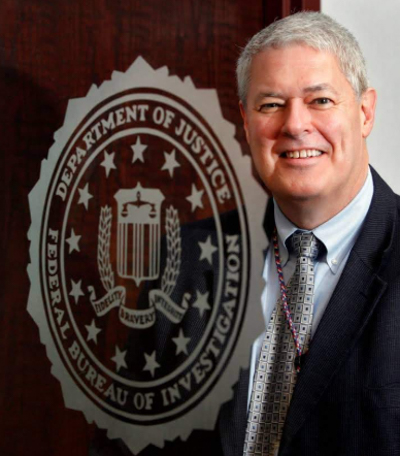
Over nearly three decades as an FBI special agent, Harry Trombitas, MS’82, worked thousands of cases covering a wide range of crimes: serial murder, homicides, kidnappings, bank robberies, organized crime, terrorism, crimes against children, criminal profiling, threat assessment, and more.
In New York, Trombitas surveilled notorious organized crime figures like John Gotti. In St. Louis, he worked on an undercover task force cracking down on auto-theft rings. In Ohio, he tracked the notorious serial sniper Thomas Lee Dillon.
In Omaha, for his first case as an FBI agent, Trombitas worked on the investigation of serial killer John J. Joubert, while supporting the parents of one of Joubert’s victims.
Trombitas (who goes by “Trom”) retired from the FBI in 2012, as required by the agency's mandatory retirement age of 57. But the cases, the killers, and the victims and their families stuck with him. A few years ago, after multiple nudges from friends and family, Trom decided to write a book chronicling his career and most notable cases. In the end, his manuscript clocked in at about 269,000 words, which is about twice as long as The Da Vinci Code and half as long as War & Peace.
“I knew I had to split it up into multiple books,” Trom says. Last year, he published his magnum opus as four separate books (about 200 pages each). Collectively, they make up the Dark Places: My Life as an FBI Special Agent series. Trom also hosts a true crime podcast called Off the Record: An FBI Agent’s Perspective.
When Trom looks back over his 29-year FBI career, he knows that it never would have happened were it not for Creighton. He’s not only an alum but was one of Creighton’s first public safety officers.
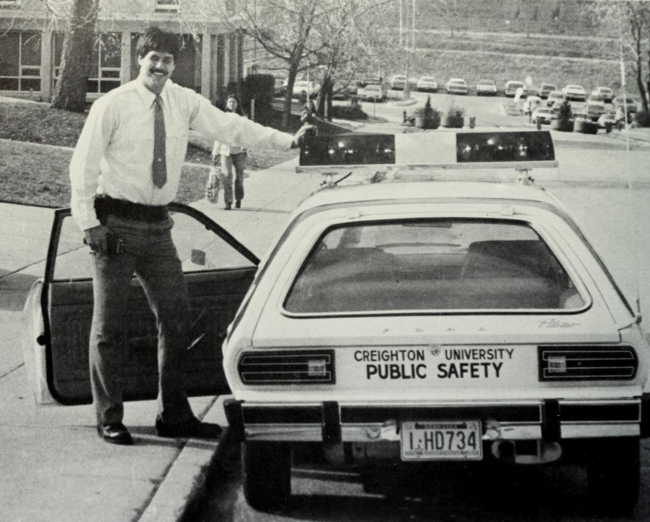
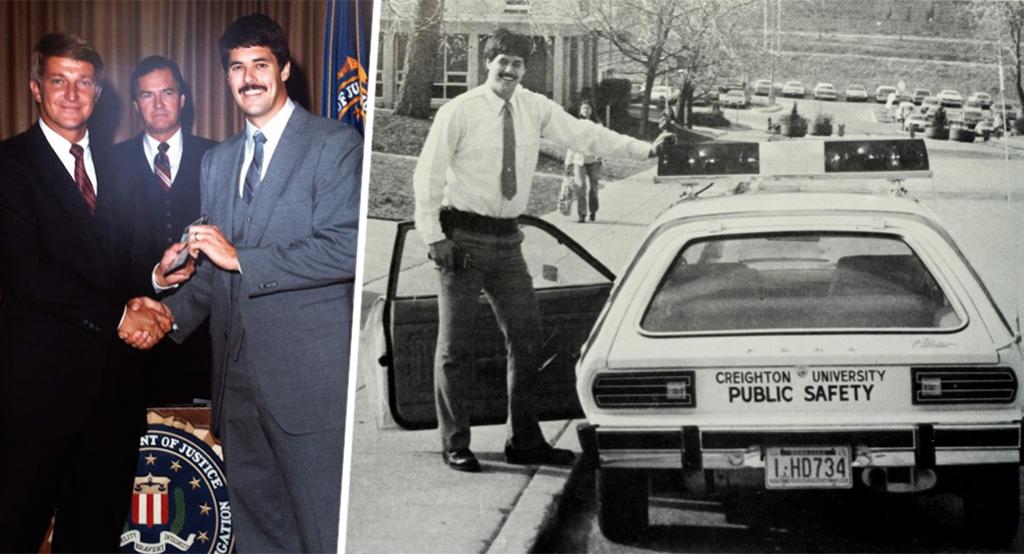
After graduating from Ohio State University with a criminal justice degree, Trom took a position as a police officer assigned to the Northwestern University campus in Evanston, Illinois. Then, his friend Jim Russell — whom Trom worked with on the OSU police department — became Creighton’s first public safety director. Russell invited Trom to join him as a supervisor in 1979.
Prior to starting its own public safety department, Creighton used various security companies. “The outside companies didn’t go well,” Trom said. “There wasn’t the mutual respect that you need between the students and public safety officers. When we helped build Creighton’s own public safety department, we wanted to get to know the students, faculty and staff and let them know that we weren’t here to intimidate but to help keep them safe. We wanted to build trust and friendships.”
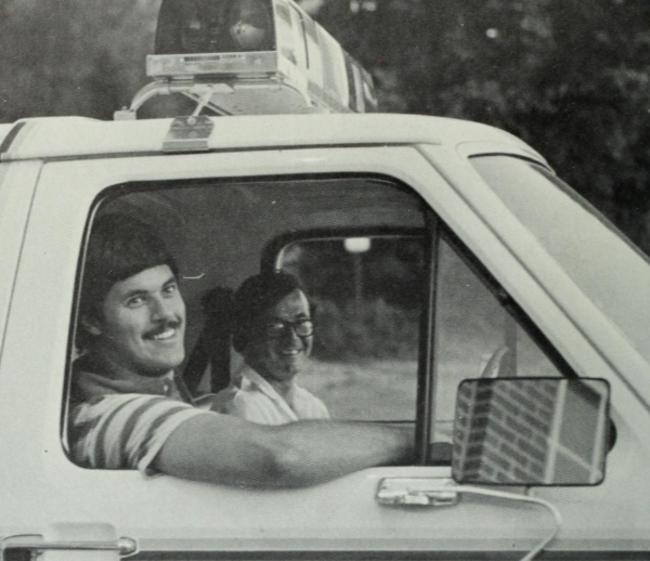
There were a lot of thefts happening across Creighton’s campus when Trom started: bikes, cars, book bags and “unattended calculators.” To prevent further crimes, the department started using “gotcha” cards. If Trom or his fellow officers saw unattended valuables or an unlocked car, they would leave “gotcha” cards behind. Among the department’s other measures, the cards — which served the rare dual purpose of public service and amusement — helped prevent thefts. Other programs the department enacted aimed to prevent less frequent but more serious violent crimes.
During his time at Creighton, Trom took advantage of the tuition remission benefit and earned a master’s degree in counseling and psychology.
“My education at Creighton really showed me what makes people tick,” Trom said. “It was extremely valuable for my FBI career because it taught me how to interview people and to listen to what they’re saying without passing judgment. That kind of approach pays off tremendously in investigations.”
Because Omaha had an FBI field office, agents regularly visited campus to recruit students. Eventually, Trom struck up a chat with one of the recruiters. Would he be interested in joining?
“I thought you had to be an attorney or an accountant to be an FBI agent,” Trom said. “But they had a new, diversified program where you could apply to become a special agent with an undergraduate degree and three years of work experience.”
Though he loved his role at Creighton, Trom and his wife, Barb Trombitas, decided he should take the leap. After passing his written exam, oral interview, background check, and physical fitness pre-employment testing, he was offered a probationary position as an FBI special agent.
He was sent to the FBI Academy in Quantico, Virginia, where he spent five months learning about federal law, the rules of criminal procedure, how to conduct criminal investigations, and becoming proficient with all the weapons used by FBI agents. He graduated from the FBI Academy in October 1983 as an official FBI special agent.
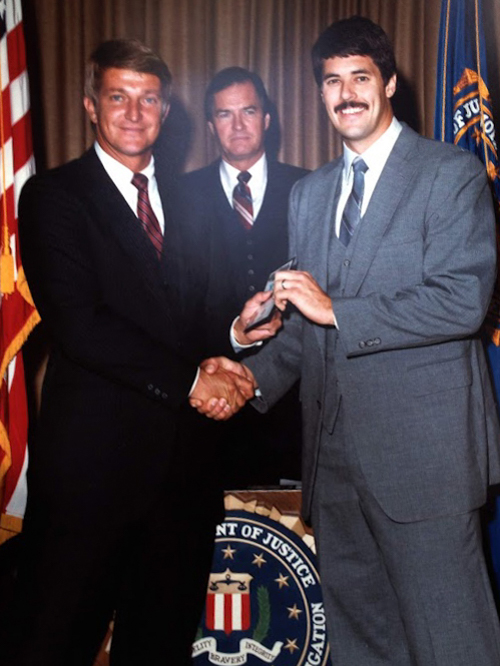
He initially returned to Omaha, where his first task was to join the aforementioned Joubert investigation. The case was heartbreaking and formative. Trom spent countless hours with the parents of a young victim.
“The trauma and the horror they went through,” Trom said. “Seeing so early in my career a case like that gave me a deep appreciation for what victims’ families go through. That’s something I’ve carried with me every day since.”
Trom’s book series is called Dark Places for a reason, of course. He’s seen some of the most horrific crimes and most disturbing facets of human nature imaginable. He’s often asked how he has remained such an upbeat and hopeful person.
“I had to compartmentalize; it was the only way not to be driven crazy,” Trom said. “Because I wasn’t only an FBI agent, but I’m a husband and a father of two.
“I’ve learned over the years that there are far more good people in the world than bad. The vast majority of people are good, honest, hard-working people. They want what’s best for their families and friends and everyone around them. There are only a few ‘bad apples’ that can’t get with the program. That’s why we have law enforcement.
“No matter how dark things got, I’ve never stopped believing that.”