Featured Testimonial About Creighton University
I’ve never had something like this. Even over the past few years, I’ve developed relationships where I can walk around the neighborhood without feeling like an outsider.
By Micah Mertes
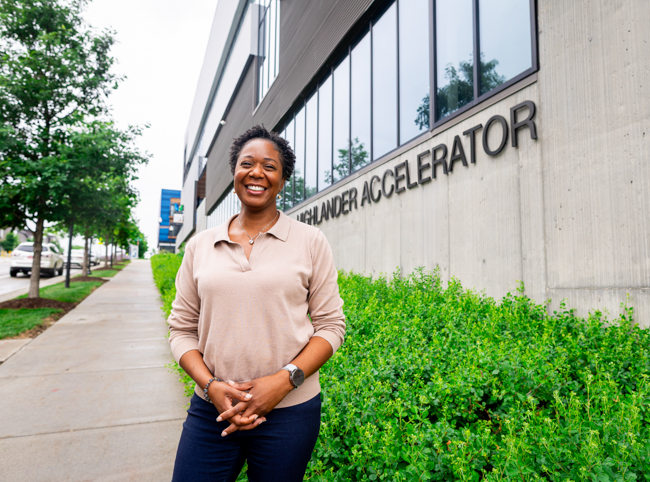
April Dixon, BS’16, MPH’19, spent most of her life connected to no particular community. As a military family, she and her siblings grew up in more than half a dozen states (including Nebraska, in Bellevue near Offutt Air Force Base).
She later enlisted herself. As an Air Force security forces officer, she served in posts ranging from Greece to South Carolina to Dhahran, Saudi Arabia.
Though she had learned to quickly adapt to her environment and make friends wherever she went, she had sought that deeper connection that comes with staying in one place for a long time.
Today, she finds herself firmly rooted in two communities. In fact, she carries both of them in her job title: North Omaha Community Engagement Director for the Creighton University Institute for Population Health.
* * *
What does your role entail as the North Omaha Community Engagement Director?
Dixon: I work with a community engagement team through Creighton’s Institute for Population Health, along with community engagement coordinator Alejandra Rebolledo-Gomez. We work with individuals and partner with North Omaha-based community organizations. The starting point is always a series of questions: “At Creighton, we have a lot of great faculty, staff and students who really want to partner with the North Omaha community. What should that look like? How do we make that work? How do we make that sustainable?”
How do you sustain it? You’ve talked about the perceived dividing line at Cuming Street. North of Cuming and south of Cuming. How do you strengthen the bond between Creighton and North Omaha and keep it strong?
I know the work we are doing — and not only at the Highlander — is moving Creighton in the direction of removing that perceived barrier, but it takes engagement that is active and consistent.
You need to engage with the community as a totally blank slate and not act like you have all the answers before you’ve even talked with anyone. That will shut down any interaction or potential for connection right off the bat. Don’t assume. Ask people in the community what their needs are. We’ve started a community advisory board with a dozen members, and we try to hear from as many different voices as possible. You have to build trust. It has to be a true partnership if you’re going to make a difference and sustain your efforts.
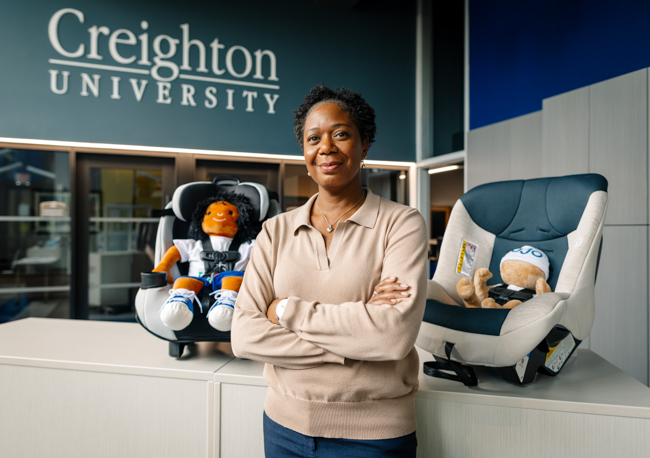
Last year, the Institute for Population Health opened a renovated space in the Highlander Accelerator that serves as the main connection point for Creighton and the North Omaha community, in addition to serving as the Child Safety Center. How is that going so far? What is the space making possible?
It’s going really well. It’s a new space. It’s a new endeavor. I think the main thing is, we want people to know that we’re here, we’re a resource, and we continue to get the word out. We’re still learning and trying to see where we fit within the community when it comes to child injury prevention. (Read more about the Child Safety Center here.)
The Institute hired Shannon Martinez as the child safety educator. We also recently hired our first community health navigator, Jabari Wright, who is advocating for those social determinants of health, whether it’s housing, food access or environmental health. Having a space that is actually in North Omaha, where we can make these connections with individuals, families and organizations where they live, makes a huge difference. We’re here, right down the street.
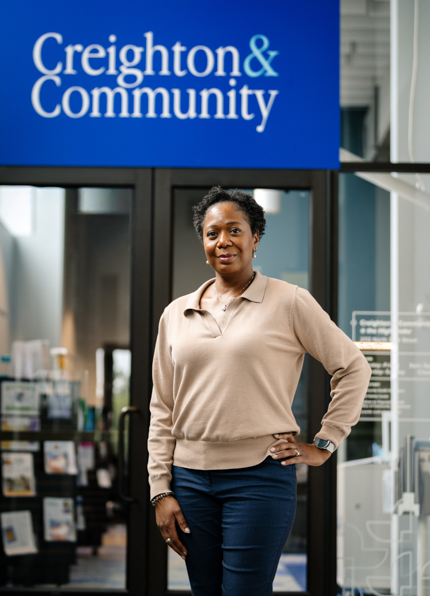
You came to Creighton 20 years ago, and your first role involved serving the North Omaha community.
I was hired as the coordinator for the Every Woman Matters program at the Creighton Community Health Center in Benson. It’s a program to help women who are falling through the cracks and not receiving adequate healthcare. I would help manage their cases, get them seen by specialists, schedule their mammograms or colonoscopies or blood panel screenings. That was my first exposure to the disadvantages people faced when it came to the social determinants of health. It really showed me the importance of education and community outreach to help people navigate their healthcare.
Which led you to become a Creighton student. (Dixon completed a bachelor’s degree in health administration and policy and a master’s degree in public health at Creighton.)
I felt so encouraged by my supervisors to pursue my degrees, even though I never felt like I had the time. Both degrees were great experiences that really helped me gain a better understanding of what health and healthcare look like.
After so much time going from one place to another, do you finally feel truly rooted somewhere, like you belong to a place?
Absolutely. I’ve worked at Creighton for 20 years. My daughter (Olivia Dixon) is a student in the Heider College of Business. My husband is the pastor of Immanuel Community Church (at 27th and Lake Streets). We live downtown. I have family in the area. I’ve never had something like this. Even over the past few years, I’ve developed relationships where I can walk around the neighborhood without feeling like an outsider. People see you, and there’s the comforting feeling of, “Yeah, I know you. You’ve been here before.”