Featured Testimonial About Creighton University

Years ago, a friend took a volunteer teaching position at Creighton Prep. It was the first introduction to Omaha for Fr. Eric Immel, SJ. And at that time, for a recent college grad who was searching for purpose, Omaha sounded fantastic.
So, Fr. Immel followed his friend’s path.
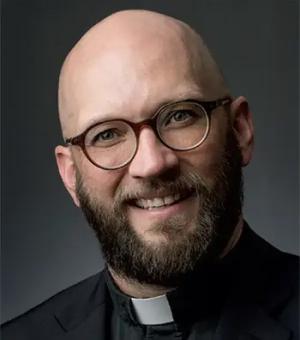
He secured his own volunteer gig at Prep and eventually found a job on Creighton’s campus. Then, he found his calling.
“It was through those three years of working at Creighton and having the experience of the Jesuits here that I finally acknowledged where God had been pulling me this whole time,” Fr. Immel said. “I applied to the Jesuits with permission from the Wisconsin province, which is now the Midwest province. They accepted me. I put in my resignation at Creighton, and my Jesuit journey began.”
Fr. Immel joined From the Mall to discuss his journey and so much more — including the importance of encouraging students to embrace community, his approach to sharing messages on Instagram and his new role as the pastor at St. John’s Church.
Below is a snippet of the conversation. The questions and answers have been edited for space and clarity.
* * *
When you're drawn to the Jesuit order, pursuing this as your vocation, how far ahead are you thinking about what your life is going to be like? Did it enter your mind that you might end up at a place like Creighton in a community with other Jesuits such as this?
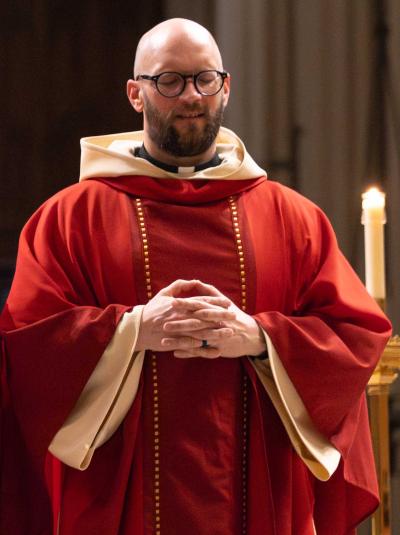
The Jesuits have what we sometimes call a charism. There's a way that we exist in the world and a way that we operate in the world, which I was pretty familiar with, given how much interaction I had with Jesuits before I actually joined the Society of Jesus myself.
We take vows. Poverty, chastity, and obedience. I like to joke: No money, no honey, Jesus is my boss. And that means that I do surrender a certain amount of my own decision-making capacities.
I knew I would give up a certain amount of control over my own life, but I think there's something deeply spiritual involved with that. (Society) talks a lot about freedom — but freedom in the spiritual sense is not about doing whatever you want, whenever you want. In fact, anybody who tries to live that way usually realizes that they are more responsible for other people than they want to admit. Freedom for us is about surrender. So, do I trust this process and this structure of community life? Do I trust that my life is going to be meaningful by the way that I share my life fully and ask to be missioned?
You attended Saint Louis University and got introduced to the Jesuits as a college undergraduate. But was there a deeper understanding you gained while working as a staff member at Creighton?
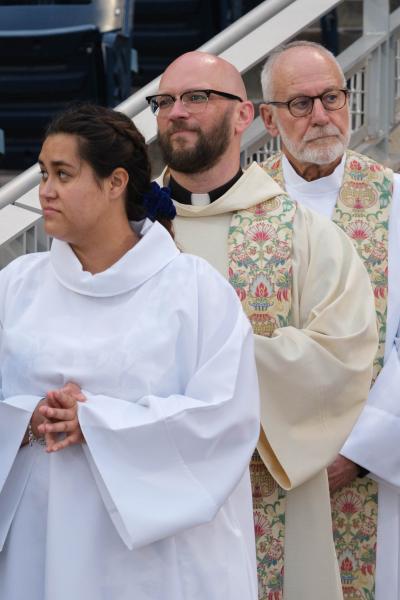
There were great Jesuits at St. Louis University, and those men helped form the bedrock of this vocation. But I just kind of bumbled along (as a student). I was involved in a lot of stuff in college. I made a lot of bad decisions. I wasn't mature enough, I think, to respond to God's invitation at that point.
I needed those years away from the Jesuits. I needed those two years in public school. I need the work experience to mature myself in order to actually consider the question. The Saint Louis University Jesuits were tremendous in helping me form this possibility, this idea, this call, but it was the Jesuits here at Creighton — when I was a little bit more mature and ready to say yes to big things — that encouraged this vocation. It was more about my own growth and development than the way that God was inviting me. I needed to mature in such a way that I could actually hear where God was calling me to be.
Back in those moments, you were working with Creighton fraternities and sororities. It must have been the crazy kids who drove you closer to God, then?
Listen, I loved that job. The late, great Fr. John Schlegel, SJ, a former president of Creighton University, said it very well. He said, “When fraternity and sorority men and women are good, they are very good. And when they're bad, they're very bad.” It was a whiplash of the amount of service and philanthropy that they did, coupled with these emails that I would get on Monday mornings about someone lighting a couch on fire. It's like, “What?”
There was just such an extreme posture, and that's college in so many ways. It's about figuring out limits. It's about understanding values and priorities. And so, I loved it.”
Tell us about St. John's Church. How excited are you to take over as pastor of this historic parish?
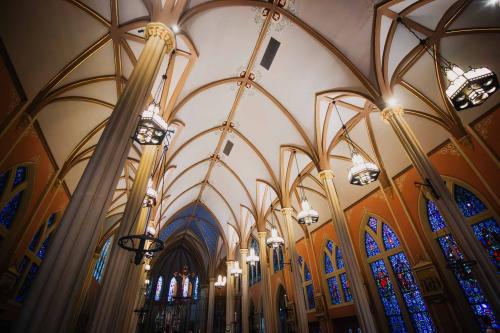
I've been saying Masses at St. John's for four years. I've gotten to know the student community and the resident community. I think that I'm known and I'm appreciated, and I know and appreciate this community. It's going to be a different pace of life, but an equally great one and a challenge that I'm looking forward to.
No matter where people worship, one can identify a sense of spiritual significance. But St. John’s is particularly special to the Creighton community. What stands out about it to you?
When I think of St. John's, I don't immediately think of the parish building or the edifice. I think of the community that gathers to worship there. Now, the benefit of having a space like St. John's is that it provides a geography in which that community is formed.
St. John's as a space is stunning — the stained glass, the way that the light shines through in the afternoon. And the stillness of it — St. John’s is an oasis, a repose from what otherwise is a pretty chaotic existence for most of the people involved here at Creighton.
There’s one definition of God that I love: God is beauty breaking through. And when you walk into St. John's, you're just flooded with the beauty of the place, and it naturally draws people, I think, into a more reflective space, a more thoughtful space, a quieter space.
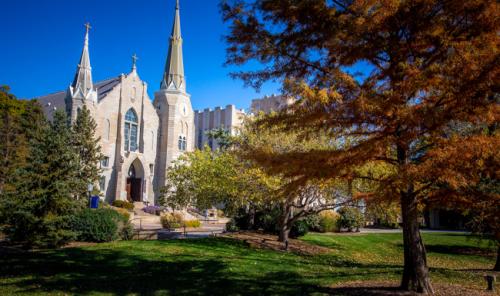
And now, starting in July, you’re the pastor in this beautiful church...
It’s a privilege to be able to occupy that space, to pray in that space. There's great history there. And there's a lot of learning that can be done. The current pastor, Fr. Matt Walsh, SJ, always points out lessons to be learned from the stained glass windows. There are figures of saints of the Church and different symbolism. That's all over the place.
If people just come and look around a little bit and really allow the space to shape them, I think the experience is pretty powerful.
There are 73 weddings at St. John's this year because alumni want to come back, and they want to have an experience of a life-changing moment in our church because of what it already means to them.
Alumni are welcome to become parishioners, too, correct?
On my gosh, yes. Come! Obviously, the Sunday night masses are more driven toward undergraduate students, but they're not the only ones there. And similarly, undergraduates come to the parish masses on Saturday and Sunday. If alumni are looking for a place to continue their growth and spiritual life, come to St. John's. Make it a part of your everyday life, make it a part of your weekly worship. You're most welcome.
* * *
Listen to more From the Mall.