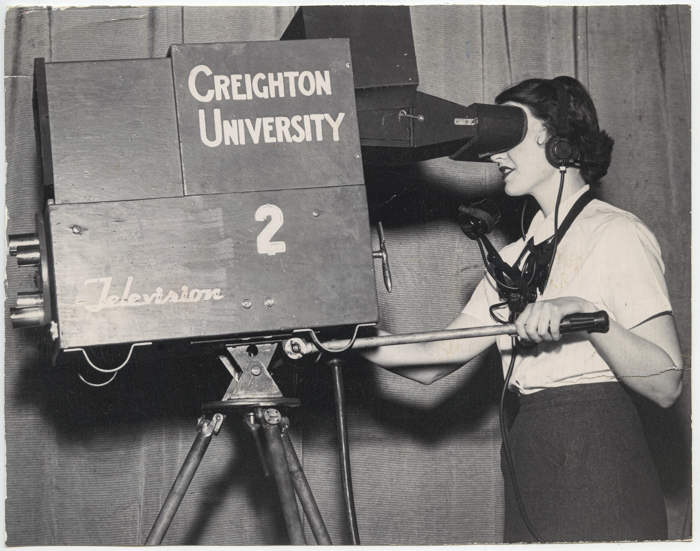
See a photo gallery of dozens of Creighton-produced TV programs below
* * *
By Micah Mertes
Not many know that Creighton University was a pioneer in television, at the forefront of the medium with a series of firsts. Creighton ...
• Was the first university to have complete TV production equipment on its campus (in Dec. 1946).
• Aired one of the first surgical operations ever televised (May 1947), performed by Creighton School of Medicine faculty at Creighton Memorial – St. Joseph's Hospital.
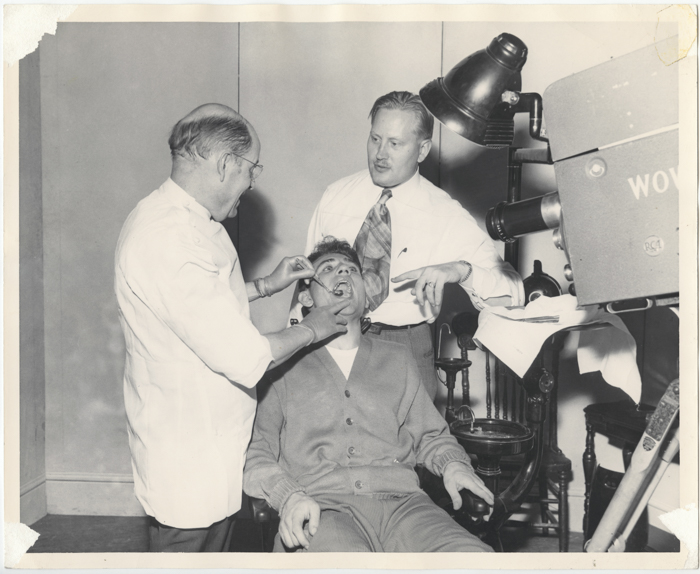
• Aired the first dental operation ever televised (July 1948), as Creighton School of Dentistry professor Dr. Lawrence A. Donahoe explored "the mysteries of the cavern of the mouth."
• Featured what was then the world's youngest TV performer, a 5-day-old infant named James from St. Catherine's Hospital, during a Creighton-produced program called "Care of the New-Born Baby" (Dec. 1949).
• Offered the first television training scholarship (1948), aired the first program from a pharmacy school (1950) and became one of the first universities to broadcast its own TV show to its home market (starting in 1949).
Why so many firsts?
There were a series of concurrent factors — a mix of good timing, ample storage space, an alumni connection and a newly arrived Jesuit passionate about the art of television production. Here's how and why it happened.
Stories like these are possible thanks to the University Archives and Special Collections
Timing and Space
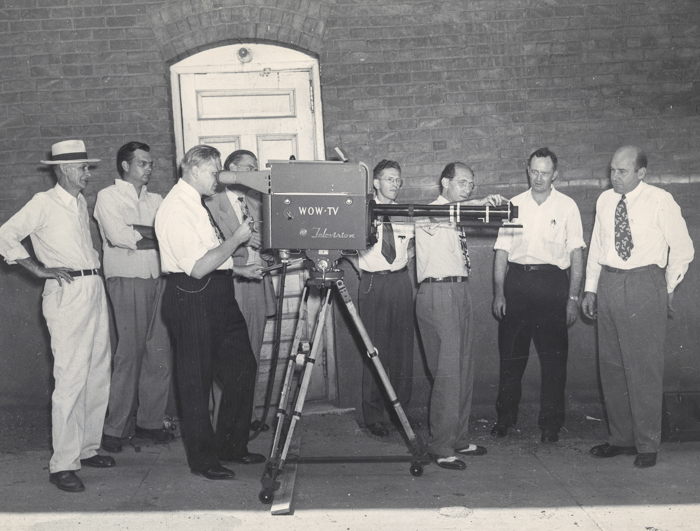
In the mid-1940s, Omaha radio station WOW, Inc., started the process of launching Nebraska's first TV station. What would become WOW-TV (now WOWT, Channel 6) was also the first TV station in most of the Midwest, going live before competitors in Iowa, Kansas and the Dakotas.
Near the end of 1946, $50,000 worth of production equipment arrived in Omaha. But WOW-TV didn't yet have a place to put it. It would be years before the station moved into its headquarters at 35th and Farnam Streets (a building designed by Creighton alumnus Leo A. Daly, Jr., BA'39). Channel 6 would not, in fact, go on the air until Aug. 29, 1949.
In the meantime, the station needed a temporary home. WOW, Inc.'s president and general manager, John J. Gillen, AB'27, LLB'31, reached out to his alma mater for a favor: Could WOW-TV store its gear on Creighton's campus for a few years?
Creighton obliged, letting the station keep its equipment in the Creighton Auditorium (built in 1902 and later demolished in 1959 to make way for the Reinert-Alumni Memorial Library).
And thus Creighton and WOW-TV embarked on a bold new experiment in the televisual arts.
The TV Jesuit
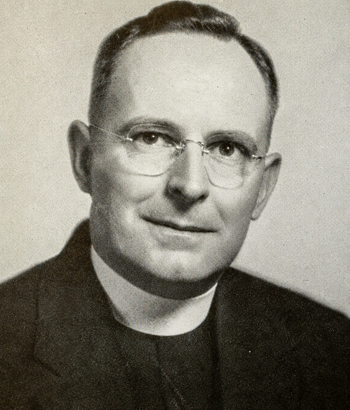
None of what happened would have happened if not for Father Roswell C. Williams, SJ.
Fr. Williams (the uncle of pioneering journalist Mary Alice Williams, BA'71) arrived at Creighton in 1945 as an English professor and director of communication arts. He was interested in broadcasting and saw a great opportunity in Creighton securing $50,000 (about $850,000 in 2026 dollars) worth of state-of-the-art equipment as the TV era dawned.
With WOW-TV, Fr. Williams enlisted students, faculty and staff to turn the Creighton Auditorium into Nebraska's first TV studio, launching an experimental closed-circuit TV network (meaning it was distributed only to TVs hardwired via coaxial cable).
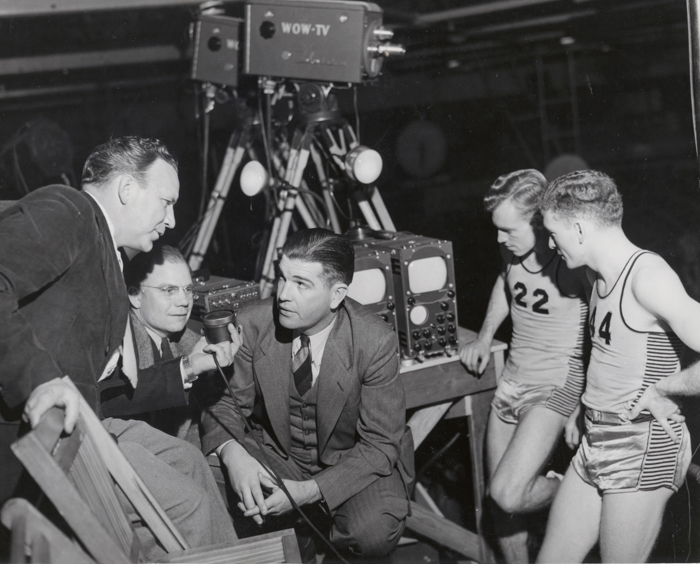
Creighton and WOW-TV's first public effort — indeed, the first-ever television exhibition in Omaha — was a Jays basketball game against Wichita State. From there, the University and station telecast baseball games, musical performances, surgeries, newscasts, magic shows, magnified projections of biological specimens and what were believed to be the first TV commercials produced in Omaha.
WOW-TV provided full technical and production staff. Creighton provided access — to places, classes, professors and students. Together, they explored what was possible in the burgeoning medium.
Multiple future broadcasters started their careers with these early experiments, including Fr. Williams' protege, Don Keough, BS'49, HON'82.
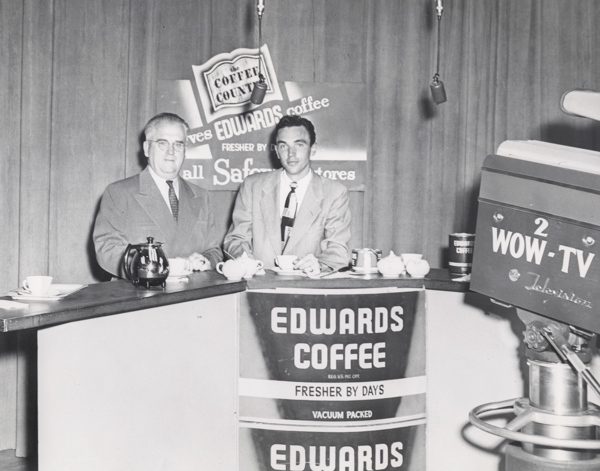
Long before he became the president of Coca-Cola Co., Keough (who passed away in 2015) produced TV programs for Creighton and WOW-TV. He even hosted his own show called The Coffee Counter, in which Keough interviewed Creighton faculty and staff. The Coffee Counter aired right before Carson's Corner, hosted by Keough's friend and fellow broadcaster, Johnny Carson.
In a 1989 Creighton magazine article by Robert T. Reilly, BA'45 ("Live From Creighton Auditorium"), Keough recalled Fr. Williams as a tireless professional "with his arms full of papers and props, cigarette in mouth — he had an elegant way of smoking — and just standing there, watching the proceedings."
Fr. Williams was a stickler for accuracy and precision, and he worried over every detail. Reilly, who was a student of Fr. Williams, wrote in 1989 that the Jesuit "rarely looked relaxed. Sometimes he was so tense, so frenetic, you could envision him flying into millions of clerical pieces."
But, Reilly wrote, Fr. Williams' intensity didn't arise from ego. "It was the consequence of a perfectionist striving for excellence without the funds and performers to achieve it. He felt that, if he let up, the whole edifice would collapse."
Creighton Goes Live
In 1949, WOW-TV left Creighton's campus for its newly built headquarters on 35th and Farnam, going on air that summer. But the University's partnership with Channel 6 was only getting started.
Fr. Williams and a group of students, faculty, staff and alumni helped launch a TV program called Creighton University Presents, which aired every other Wednesday afternoon for several years. The show was at various times called Doors of Knowledge or, if health sciences-focused, To Your Health.
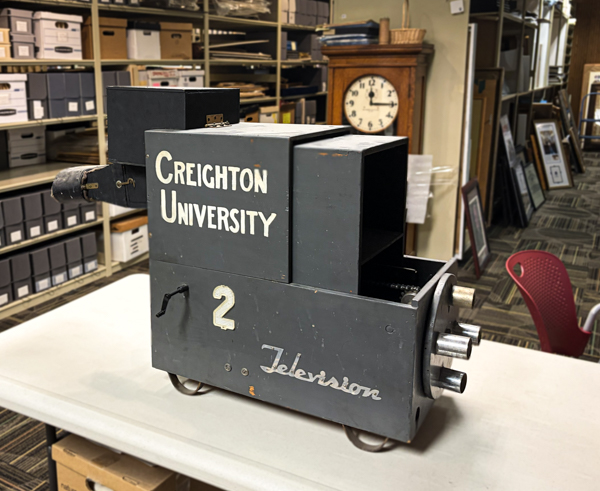
Although the Creighton show was shot at WOW-TV, the student production crew and on-air talent needed a different location for rehearsals. The Creighton Auditorium remained their makeshift TV studio.
Creighton couldn't afford the $40,000 studio camera that WOW-TV took with them, but Williams was crafty. With the help of a physics professor, he built two $150 replicas, known as "The Creighton University Rehearsal Cameras."
From the aforementioned 1989 Creighton magazine article:
"(The camera) consisted of a wooden box fitted with lenses that could emulate the views common to the electronic original and had a switch that could produce the red light as a signal to performers. With this inexpensive tool, Fr. Williams could rehearse talent, set up a shot chart and package a show for distribution."
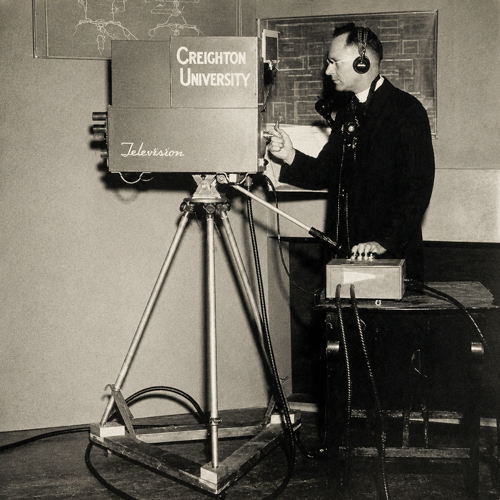
Through these on-campus rehearsals followed by live broadcasts, Creighton produced hundreds of programs over the next 15 years. Topics ran the gamut — the Civil War, communism, the human brain, legal aid, income taxes, blood types, breakthroughs in healthcare and much more. (See a photo gallery of dozens of these shows below.)
In every instance, Fr. Williams called upon faculty, staff and students across all schools and colleges to lend their expertise for the entertainment and edification of their Omaha audience.
This University-wide cooperation, distinctly Creighton, was the key to making the whole endeavor possible, Fr. Williams said in the early 1950s.
Fr. Williams: "Despite the television 'firsts' which Creighton can justly claim — whether in programming or equipment — we realize, of course, that much more might have been done. With a larger faculty, with more abundant resources, many more possibilities might have been realized. But would they have been? Can the cooperation we have at Creighton — of administrative officers, faculty, students, alumni, office and maintenance workers — readily be duplicated elsewhere?
Certainly, money alone cannot buy cooperation of that sort. If it can, why is Creighton rightly able to claim so many 'firsts' in a field where others have had much greater support in the way of material resources?"
Stories like these are possible thanks to the University Archives and Special Collections